Authors: Yang Zirong, Xu Qiyuan; Source: Finance Mayflower
The yield on long-term U.S. Treasury bonds is not only the borrowing cost for the U.S. government, but also a pricing anchor for the global financial system. A rise in the central level of long-term U.S. yields will have an impact cascading down from U.S. households and businesses, ultimately affecting global financial markets.
Recently, yields on long-term U.S. Treasury bonds have risen rapidly. On the surface, rebounding inflation and rising short-term interest rates are the direct driving forces, but in the medium to long term, the deeper driving force lies in the trend of the term premium returning to normal.
The continued expansion of government bond supply, weakening traditional demand forces, and rising macroeconomic policy uncertainty have collectively driven up term premiums, and these structural factors are unlikely to reverse in the short term. Therefore, it can be concluded that the US is unlikely to return to the low-interest-rate era following the 2008 financial crisis. It should be noted that this does not mean that long-term yields will remain at an absolute high indefinitely; they will continue to fluctuate with economic cycles, inflation trends, and changes in the Federal Reserve's monetary policy, but their central level has risen significantly, which will have a profound impact on the US and even the global economy and finance.
Term premium is the main factor
Since the third quarter of 2026, yields on long-term U.S. Treasury bonds have risen rapidly. The 10-year Treasury yield once broke through 5.3%, and the 30-year Treasury yield broke through 5.6%, both reaching new highs in more than two decades. The market is highly focused on whether long-term yields will continue to rise and where they will peak. However, a more thought-provoking question is how long will U.S. long-term Treasury yields remain at such high levels?
According to Bernanke's three-factor analysis framework, long-term Treasury yields can be decomposed into three main components: expected short-term real interest rates, inflation compensation, and term premium. From a medium- to long-term perspective, the rise in US long-term Treasury yields is not a recent phenomenon. The yield on 10-year US Treasury bonds rebounded rapidly from its 2020 low and has remained high since 2023—even against the backdrop of declining US inflation and the Federal Reserve initiating a rate-cutting cycle, it has not fallen significantly. As of September 2026, the yield on 10-year US Treasury bonds is expected to have increased by approximately 310 basis points compared to the end of 2019 (Figure 1). Specifically, the three factors contribute significantly differently to this.
First, the contribution of short-term real interest rates is expected to be limited. When the market anticipates a rise in potential economic growth, a tight labor market, and the need for the Federal Reserve to maintain a relatively restrictive policy stance, expectations for short-term real interest rates will shift upward, pushing up long-term yields. Conversely, if the market believes that economic growth is slowing, there is excess savings, or the neutral interest rate remains low for an extended period, the central level of long-term yields will decline. Compared to the end of 2019, the US expects short-term real interest rates to rise by about 60 basis points. This reflects, to some extent, that the market no longer expects the Federal Reserve to return to the zero lower bound on interest rates, and that due to factors such as fiscal expansion and the AI (artificial intelligence) investment boom, estimates of the real equilibrium interest rate have generally been revised upward. In particular, in September 2026, the US composite PMI (Purchasing Managers' Index) jumped to 58.4, indicating stronger-than-expected economic growth, and the Federal Reserve restarted interest rate hikes, directly driving up US long-term Treasury yields at an accelerated pace.
Second, inflation expectations contribute the least. When investors expect future inflation to be systematically higher than previous levels, they demand higher nominal yields to protect purchasing power, thus pushing up long-term Treasury yields. The US 10-year breakeven inflation rate plummeted to about 0.5% in March 2020, reflecting the market's extreme fear of global deflation at the beginning of the pandemic. Subsequently, with massive fiscal stimulus and monetary easing pushing up inflation expectations, this indicator surged to about 3% in 2022, and has since stabilized roughly in the 2.2%-2.4% range. Currently, the market seems to have anchored inflation expectations at a level slightly above 2%, consistent with partial deglobalization, more volatile energy costs, and structurally expansionary fiscal policies. Interestingly, despite the US-Iran conflict pushing up oil prices this year, US inflation expectations have remained relatively stable, mainly due to the fact that energy prices have not yet been transmitted to a wider range of goods and services, and limited wage increases. Compared to the end of 2019, current inflation expectations have only increased by about 20 basis points.
Third, the reversion of the term premium is the most significant contributing factor. The term premium represents the additional return investors demand for holding long-term bonds rather than rolling over short-term bonds. It is not directly determined by economic fundamentals but rather reflects risk perception and the bond supply and demand structure. When market concerns rise regarding fiscal sustainability, inflation volatility, policy uncertainty, or changes in overseas demand, investors demand a higher term premium. The ACM 10-year term premium hit a historic low of -1.66% in March 2020 and then began to fluctuate and recover in negative territory. During the rate-cutting cycle in the second half of 2024, the term premium crossed the zero line from negative territory and returned to positive territory. Compared to the end of 2019, the current term premium has increased by approximately 170 basis points.
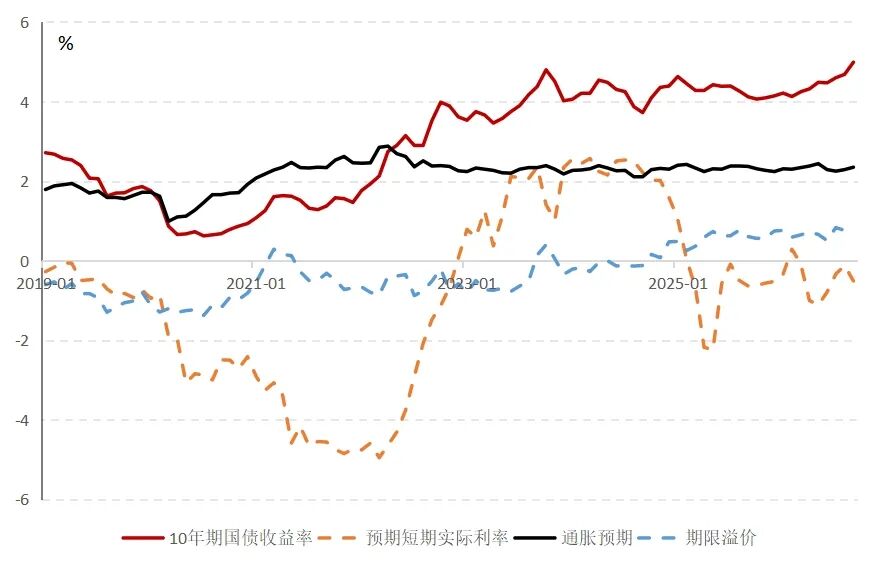
(Figure 1: Drivers of the US 10-Year Treasury Yield) Note: Expected short-term real interest rate is the difference between the 3-month US Treasury yield and the University of Michigan's 1-year inflation forecast; inflation forecast is the 10-year breakeven inflation rate; term premium is the ACM 10-year Treasury term premium. Data source: US Treasury Department, Federal Reserve Bank of New York.
The central level of long-term government bond yields rose.
The factors driving the term premium back to its original level are structural, and their influence is likely to continue to strengthen rather than weaken in the future. This means that the return of the term premium will systematically push up the central level of US long-term Treasury yields.
First, from the supply side, the supply of US Treasury bonds continues to increase, and the market needs to absorb more duration risk. Currently, the total debt of the US federal government has exceeded $40 trillion, and the ratio of publicly held federal government debt to GDP is approaching 100%. According to the CBO (Congressional Budget Office), US fiscal spending will be rigid over the next decade. Against the backdrop of increasing interest burdens, the fiscal deficit rate will remain at a high level of around 6% on average, and the ratio of publicly held federal government debt to GDP will rise to about 120% around 2035. This means that the demand for US fiscal financing will continue to expand, and the market needs to absorb an increasingly large supply of Treasury bonds, putting systemic upward pressure on long-term yields.
It should be noted that although the US Treasury is currently adopting a strategy of maintaining the issuance of medium- and long-term Treasury bonds as much as possible and relying mainly on increasing short-term Treasury bills to meet rising financing needs, this can only marginally curb the accelerated rise in term premiums. It cannot truly reduce the already high term premiums because the overall increase in debt size means that the total duration the market needs to absorb is still increasing. More alarmingly, if market confidence in the sustainability of US government debt wavers, it will further push up term premiums. For example, on August 1, 2023, Fitch downgraded the US sovereign credit rating by one notch from AAA to AA+; on May 16, 2025, Moody's downgraded the US sovereign credit rating from Aaa to Aa1. Both downgrades triggered a significant increase in the 10-year Treasury term premium.
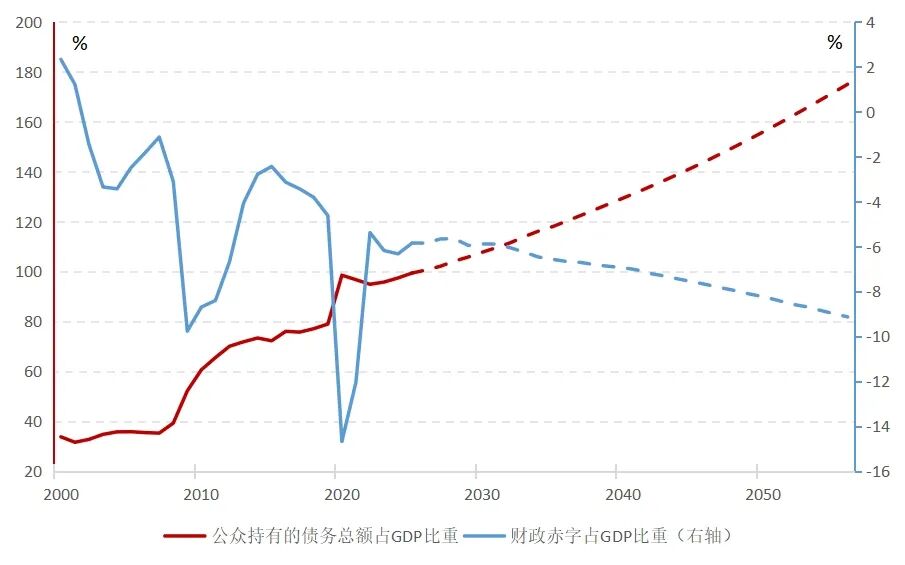
(Figure 2: Trends in U.S. federal government debt) Data source: Congressional Budget Office.
Second, from the demand side, the demand structure for US Treasury bonds is undergoing profound changes. For a long time, overseas investors and the Federal Reserve have been the two major stable absorbers of US Treasury bonds. However, against the backdrop of the ever-expanding scale of US debt, this demand structure is becoming increasingly unstable. On the one hand, the proportion of US Treasury bonds held by overseas investors peaked at 50.2% in 2013 and has since declined, falling to 33% by 2025. Since 2026, foreign official investors have been significantly reducing their holdings of US Treasury bonds, whereas traditionally they have primarily held medium- and long-term interest-bearing bonds. This means that the marginal pricing power of long-term US Treasury bonds is shifting from price-insensitive foreign official investors to price-sensitive private investors.
On the other hand, although the Federal Reserve's holdings of US Treasury bonds briefly increased during the 2008 financial crisis and the 2020 COVID-19 pandemic through massive balance sheet expansion, this percentage quickly declined once the Fed stopped expanding its balance sheet. If the Fed, under Chairman Warsh, pushes for further balance sheet reduction in the future, the size of the Fed's holdings of US Treasury bonds will continue to decrease. Therefore, neither overseas investors nor the Fed can keep up with the pace of expansion of US Treasury bonds. This supply-demand gap means that the private market must bear more of the duration risk of Treasury bonds, and private investors, who are more sensitive to price, will demand higher risk compensation, driving up the term premium.
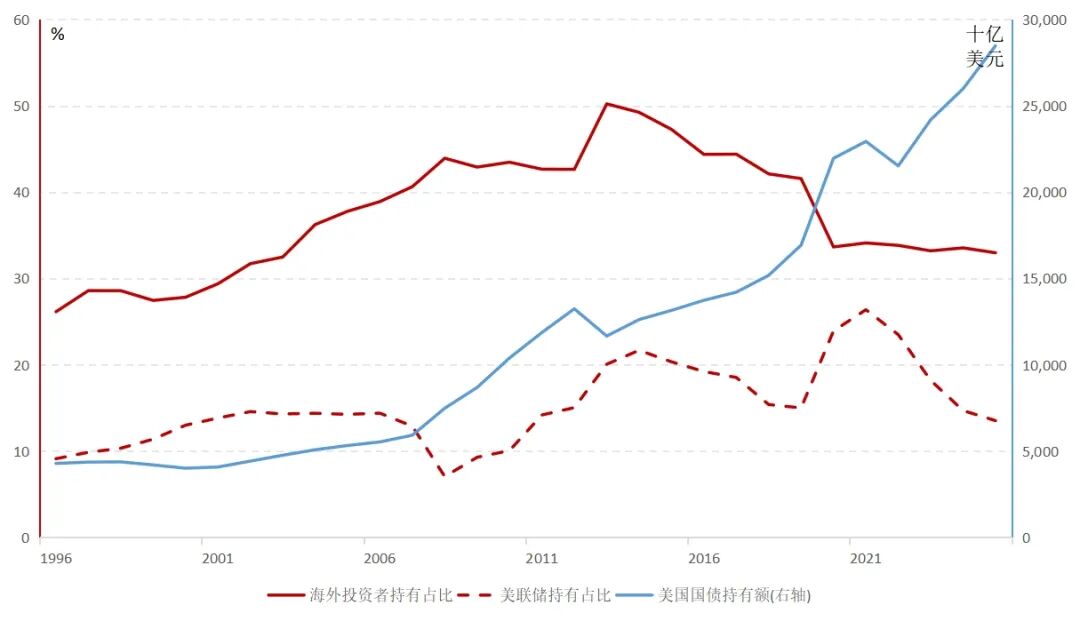
(Figure 3: Structure of U.S. Treasury Holders) Data source: U.S. Treasury Department.
Third, increased uncertainty raises the risk premium requirements for long-term bonds. Uncertainty stems from at least three levels: First, energy supply shocks, tariff changes, global supply chain restructuring, and expansionary fiscal policies are all widening the range of US inflation fluctuations and potentially altering medium- to long-term price paths. This increased asymmetry in inflation risk directly pushes up the risk premium for holding nominal bonds. Second, although the probability of a US government debt default remains low, the risk of fiscal unsustainability does exist, and the lack of a binding medium-term fiscal management framework in the US makes the path of spending and tax policies difficult to predict. This fiscal policy uncertainty further increases the risk premium for long-term Treasury bonds. Third, long-term investors need to judge the policy interest rate path for the next few years. Recurring inflation, changes in the Federal Reserve's policy response function, and adjustments to forward guidance communication methods all increase the price volatility risk during the holding period of long-term Treasury bonds, prompting investors to demand a wider term premium.
What will be the impact on global financial markets?
The yield on long-term U.S. Treasury bonds is not only the borrowing cost for the U.S. government, but also a pricing anchor for the global financial system. A rise in the central level of long-term U.S. yields will have an impact that cascades through U.S. households and businesses, ultimately affecting global financial markets.
First, borrowing costs for U.S. households are rising, and financial affordability is deteriorating. Firstly, the 10-year Treasury yield is the core pricing benchmark for U.S. mortgage rates. With the rise in the 10-year Treasury yield, the U.S. 30-year fixed mortgage rate has surged to 7.28% in the week ending October 1, 2026, which will directly dampen activity in the U.S. housing market. Secondly, the debt situation of U.S. households is worsening. For example, the 90-day or longer auto loan default rate rose to 5.5% in the second quarter of 2026, exceeding the peaks during the 2008 financial crisis and the 2020 COVID-19 pandemic.
Second, rising financing costs for US companies are putting pressure on investment and valuations. On the one hand, the rising central level of long-term yields means that the absolute financing cost of corporate bonds is increasing, which may inhibit future investment and profit growth. Of particular concern is the risk of refinancing. Starting in 2027, the scale of US corporate debt maturities will increase significantly, forcing companies to refinance at costs far higher than during the pandemic. Data from the London Stock Exchange Group shows that between 2027 and 2031, approximately $4.3 trillion in non-financial corporate bonds issued in the US market will mature; the annual debt repayment will increase from approximately $572 billion in 2027 to $1.03 trillion in 2030. On the other hand, higher long-term Treasury yields will put pressure on the valuations of listed companies, with long-term growth companies being particularly sensitive. Historically, a sustained rise in US long-term Treasury yields has often led to a significant correction in the stock market, and a 5% 10-year Treasury yield is considered a significant psychological threshold by the market.
Third, the US financial stability risks are accumulating, and weak links are facing tests. On the one hand, the upward shift in the central level of long-term Treasury yields will be transmitted through layers of housing, commercial real estate, and highly leveraged enterprises. The commercial real estate sector is particularly vulnerable, with both office vacancy rates and commercial real estate loan default rates rising significantly. A Cushman & Wakefield report shows that by the end of 2025, the national office vacancy rate in the US will reach 20.4%, a record high. Trepp data shows that the delinquency rate for commercial mortgage-backed securities in office buildings climbed from 6.5% at the beginning of 2024 to 11.0% at the beginning of 2026. On the other hand, financial intermediaries such as banks and insurance institutions, which hold large amounts of long-term bonds, face the risk of unrealized losses on their portfolios when yields rise rapidly; the Silicon Valley Bank incident in 2023 serves as a cautionary tale. In the first quarter of 2026, the unrealized gains (losses) of FDIC-insured institutions rebounded again to -$325.1 billion.
Fourth, the global spillover effects are becoming apparent, with emerging markets bearing the brunt. Rising US long-term Treasury yields attract capital flows to dollar assets, strengthening the dollar and tightening overseas financial conditions, making it more difficult for lower-rated companies, highly indebted governments, and emerging market borrowers to refinance. Studies show that rising US long-term Treasury yields will lead to currency depreciation and stock price declines in emerging markets. Recently, the dollar index has risen to 102, putting pressure on emerging market currencies and stock markets, particularly those economies with high current account deficits, weak foreign exchange reserves, heavy external debt burdens, and high energy dependence on imports.
(Yang Zirong is the deputy director of the Global Macroeconomic Research Office at the Institute of World Economics and Politics, Chinese Academy of Social Sciences; Xu Qiyuan is the deputy director of the Institute of American Studies, Chinese Academy of Social Sciences.)
Source:Global Cybersecurity Alliance (GCSA)
Website:www.gcsa.org
Get updates in your inbox
We respect your privacy. See our Privacy Policy