Written by: Xiaobing | Deep Tide TechFlow
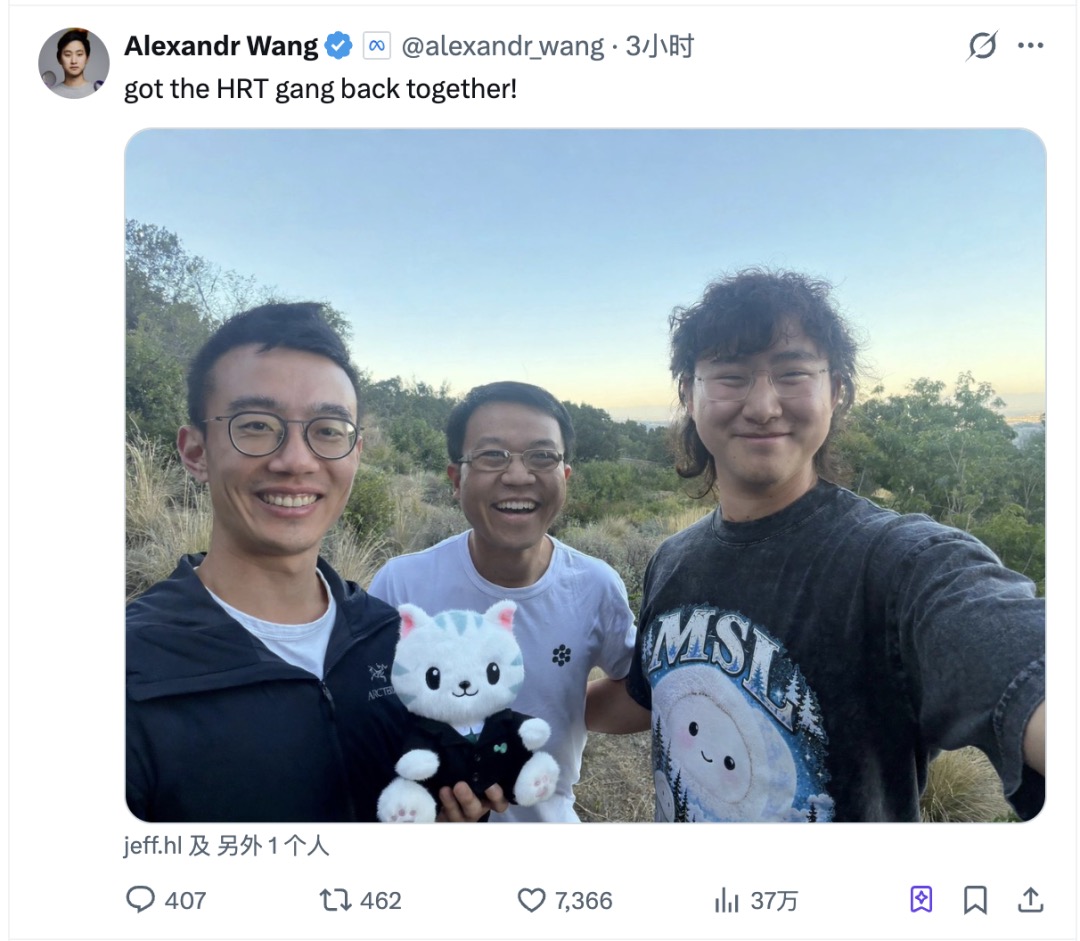
On October 19, 2026, Meta's Chief AI Officer, Alexandr Wang, posted a selfie on X with a caption of only seven words: "got the HRT gang back together!"
The comments section exploded.
This seemingly casual group photo hides one of the most outrageous facts in today's tech world: the three people in the photo, along with several of their former classmates who were not present, participated in the first internship program of Hudson River Trading, a Wall Street quantitative trading giant, in the winter of 2015. That program only recruited 10 people in total.
Ten years later, the companies founded or led by these 10 interns were valued at a combined total of over $100 billion.
The person on the right in the photo is Wang himself, 29 years old, founder of Scale AI. Last year, Zuckerberg poached him from Meta for $14.3 billion to become Chief AI Officer and head Meta's superintelligence lab.
On the left is Jeff Yan, founder of Hyperliquid, a decentralized exchange built with zero funding and an 11-person team. Last year, it made a profit of $900 million and has a market value of $76 billion.
In the middle is Scott Wu, founder and CEO of Cognition, whose AI programming agent Devin is growing at a rate of 50% per month to reach enterprise clients, and the company's latest valuation is $48 billion.
The last time the three of them were in a room together was probably in the winter of 2015, in the trading company office by the Hudson River.
Winter on the Hudson River
The connection between these geniuses began in high school.
Jeff Yan and Scott Wu have both won gold medals in the International Olympiad in Informatics (IOI), with Wu winning three gold medals, including a perfect score in 2014. Alexandr Wang is a regular participant in the US Computer Olympiad and the US Mathematical Olympiad, and they repeatedly meet in various summer camps and training teams; the circle is so small that almost everyone knows each other.
In the winter of 2015, these competitive teenagers scattered across Harvard and MIT were brought together by a common name: Hudson River Trading.
HRT is one of the world's leading quantitative trading firms, headquartered in New York, and its daily trading volume once accounted for more than 15% of the US stock market.
In the winter of 2015, HRT tried recruiting interns for the first time. There were very few positions available, only 10 in total. Jeff Yan was a junior at Harvard at the time, Scott Wu was a freshman, and Alexandr Wang was a freshman at MIT.
The internship program itself was designed to be very "quantifiable": it lasted three weeks and was conducted in a competition format, with rankings for each round. Jeff Yan later recalled that the top two in each round were always him and Scott Wu.
But the most historically significant moment of this internship might not have been the trading competition itself. According to an in-depth interview with Jeff Yan by Colossus magazine, it was during his internship at HRT that Yan first heard about Bitcoin from two former partners. Although he didn't act immediately, he soon found the Ethereum yellow paper and read a description of a computer that runs globally and no one can shut down. That seed grew into Hyperliquid a few years later.
Also that winter, 19-year-old Alexandr Wang said something to his Harvard and MIT classmates sitting around the table at his birthday party that has been quoted repeatedly since:
"Why can't it be us?"
Three roads, one origin.
After leaving HRT's offices, these young people chose completely different paths. But they share a common underlying logic: to restructure a traditional industry using algorithmic thinking.
Alexandr Wang: From Data Labeling to Zuckerberg's AI Brain
After leaving HRT, Wang made a decision that surprised everyone: he dropped out of MIT.
In 2016, at the age of 19, he co-founded Scale AI with Lucy Guo. What they did didn't sound glamorous at all; it was simply labeling AI training data. But Wang's judgment was extremely accurate: he skipped specific AI applications and directly bet on the "shovel" of the entire AI industry.
As the AI wave sweeps the globe, Scale AI has become a core supplier for giants such as OpenAI, Meta, and the U.S. Department of Defense. In 2021, the company's valuation soared to $7.3 billion, making 24-year-old Wang the world's youngest self-made billionaire. In its 2024 funding round, Scale AI's valuation reached $13.8 billion, backed by Nvidia, Amazon, and Meta.
Then came the deal that shook Silicon Valley in June 2025. Meta acquired a 49% stake in Scale AI for $14.3 billion, valuing the company at $29 billion. As a key condition of the deal, Zuckerberg required Wang to join Meta as Chief AI Officer and lead the newly established "Meta Superintelligence Lab".
A 28-year-old has become the chief architect of the AI strategy for the world’s largest social media empire.
Jeff Yan: From Quantitative Trader to Builder of On-Chain Financial Infrastructure
If Wang chose the "shovel business" of AI, Jeff Yan chose the most hardcore path in the crypto world: rebuilding transaction infrastructure.
After graduating from Harvard, Yan didn't rush into starting his own business. He worked at Google and a self-driving car company, while constantly observing the crypto world. In 2020, he founded Chameleon Trading, a cryptocurrency market maker. This experience gave him a deep understanding of the structural flaws of centralized exchanges, and the collapse of FTX provided a decisive blow.
In 2022, Yan disbanded the Chameleon team and began building Hyperliquid, a decentralized perpetual contract exchange running on the blockchain, using his own funds. Without VC investment or token pre-sales, the team of 11 people started from scratch.
This "anti-VC" approach is almost unheard of in the crypto industry. Yan's confidence stems from the trading profits accumulated by Chameleon, but even more so from the quantitative traders' relentless pursuit of product excellence: low latency, high throughput, and a user experience that approaches or even surpasses that of centralized exchanges.
ICE CEO Jeffrey Sprecher once said that Hyperliquid's trading activity "surpassed Nasdaq's".
Today, Hyperliquid is one of the most profitable companies in the world. Last year, the company's mere 11 employees generated over $900 million in profit. In just four years, the company has already reached a market capitalization of $76 billion.
Scott Wu: The man who lets AI write its own code
Scott Wu boasts the most impressive competitive achievements among this group. He has won three IOI gold medals, including a perfect score in 2014, the MathCounts national championship, and third place in the Google Code Jam. After two years at Harvard, he dropped out and co-founded the AI social networking platform Lunchclub.
But what truly made him famous in Silicon Valley was Cognition, which he co-founded with Steven Hao and Walden Yan (the three of them collectively hold 5 IOI gold medals) at the end of 2023. In March 2024, Cognition released Devin, a product touted as "the world's first AI software engineer," capable of independently planning, writing, testing, and deploying code.
Devin sparked huge controversy in the tech world, but the market gave its own answer: Cognition's valuation soared from $350 million in early 2024 to $10.2 billion in September 2025, and then to $26 billion in May 2026 (after raising $1 billion). Its annualized revenue skyrocketed from $5.4 million in mid-2024 to nearly $500 million in mid-2026.
By September 2026, annualized revenue had approached $1 billion, and the latest valuation was reportedly $48 billion. Wu himself said that over 90% of Cognition's internal code is now written by Devin himself.
A three-year-old startup saw its valuation increase from 350 million to 48 billion, a more than 130-fold increase.
More than three people
There were only three people in that selfie today, but the circle is far larger than a single photo can contain.
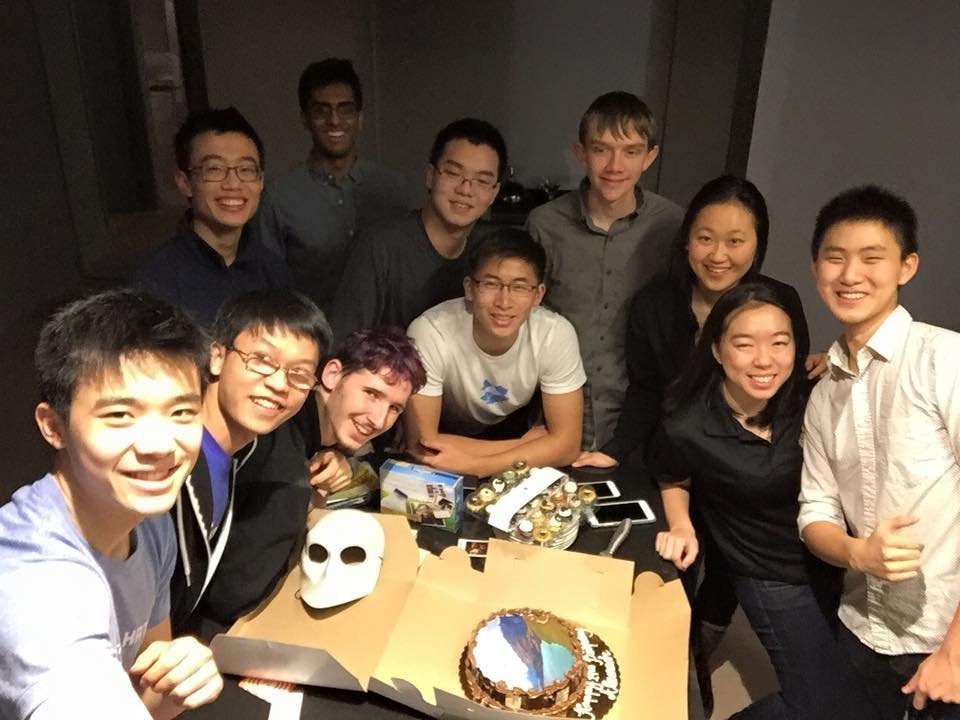
According to Scott Wu himself, the HRT internship program wasn't the starting point of this group's friendship. Many of them had already met during high school through various Olympiad competitions. And the names that emerged from that small circle all now hold a place on today's technological landscape.
Jesse Zhang, one of the same batch of HRT interns, previously founded Lowkey, a social gaming company that was acquired by Niantic (the developer of Pokémon Go). In 2023, he founded Decagon, an AI-powered customer service agency focused on using AI to replace enterprise customer service. In less than three years, the company has reached a valuation of $4.5 billion, with clients including giants like Duolingo and Hertz. It was named to Forbes' 30 Under 30 list in 2026.
Johnny Ho, a three-time IOI gold medalist and Harvard alumnus, knew Scott Wu and Jeff Yan since high school. In a 2013 photo of the US IOI team, he stood side by side with Steven Hao and Scott Wu.
After leaving the competitive gaming world, Ho worked as a quantitative trader at Tower Research Capital before joining Quora as an engineer. In 2022, he co-founded the AI search engine Perplexity with Aravind Srinivas and others, where he currently serves as co-founder and chief strategy officer. Perplexity's latest funding round has reportedly valued the company at approximately $30 billion, and it is redefining the trillion-dollar search engine market.
Demi Guo (郭文景), a "genius girl" from Hangzhou, was a silver medalist at the 2015 International Olympiad in Informatics (IOI). She holds a bachelor's degree in mathematics and a master's degree in computer science from Harvard University and was once the youngest full-time researcher at Meta AI Research. In 2023, she dropped out of her Stanford PhD program and co-founded Pika, an AI video generation platform, with classmate Chenlin Meng. Pika is valued at $470 million and has over 16 million users. She interned at HRT and Quora, placing her within the same industry.
Steven Hao, a 2014 IOI gold medalist, graduated from MIT with a degree in mathematics. He was an early core engineer at Alexandr Wang's Scale AI project and later joined Scott Wu's Cognition as co-founder and CTO. According to Forbes estimates, the 30-year-old Hao has a net worth of approximately $1.3 billion, making him the youngest American on the 2026 Forbes 400 list of billionaires.
Hao's trajectory clearly illustrates the "talent flow" within this circle: he brought his engineering experience and understanding of AI data accumulated in Scale AI to Cognition. Meanwhile, Cognition's three founders, Wu, Hao, and Walden Yan, collectively hold five IOI gold medals, directly infusing the algorithmic thinking honed in these competitions into the core architecture of their AI programming agents.
Why have quantitative trading firms become a cradle for founders?
This is no coincidence.
When Wang shared the 2015 intern group photo in early October, he added a caption: "HRT 2015 intern class is the new-gen PayPal Mafia."
The story of the PayPal Mafia is well-known. Elon Musk, Peter Thiel, Reid Hoffman, David Sacks, and others came from the same company and went on to found companies like Tesla, Palantir, LinkedIn, and Yammer, defining the tech landscape of the last decade.
But the HRT group and the PayPal Mafia have a fundamental difference. The PayPal Mafia's bond was a company and a shared entrepreneurial experience. The HRT group's bond was earlier and deeper; they shared a way of thinking.
What does it mean to have a background as a competitive athlete?
This means they are trained from their teens to solve problems using optimal thinking, have an almost obsessive pursuit of efficiency, and an intuitive understanding of complex systems. Quantitative trading firms are natural amplifiers of this mindset: at HRT, they learned how to extract signals from massive amounts of noise, how to make decisions within millisecond-level time windows, and how to build self-optimizing systems.
In an article, Jesse Zhang wrote: "The generation that grew up doing math, programming, and science competitions makes up a disproportionately high percentage of today's founders."
Quantitative trading firms serve as a crucial stepping stone for these individuals, transitioning from the competitive trading world to the startup scene. Names like Jane Street, Citadel, DE Shaw, and Two Sigma all share similar backstories, but the concentration of HRT's 2015 class was exceptionally high.
Of the 10 interns, at least 4 became founders of unicorn companies, with a combined company valuation exceeding $100 billion. This "talent conversion rate" surpasses that of tech giants like Google and Meta, which are known for producing AI talent.
A deeper reason may lie in the fact that these quantitative trading firms offer not only technical training, but also an instinctive understanding of market structure. Wang applied this understanding to AI data infrastructure, Yan to on-chain financial infrastructure, Wu to the automation of software engineering, Zhang to the reconstruction of customer service, and Ho to the disruption of search engines.
They solved different problems, but their approach to breaking down the problems was the same: find an inefficient system and rebuild it using algorithms and engineering capabilities.
Geniuses always meet early. But the truly moving part of this story isn't how smart they were. Their gold medals in competitions had already proven their intelligence. The moving part is that the era has finally turned to their turn.
Ten years ago, what was the profile of this group? Math competition champions, programming geeks, social butterflies. In the hierarchy of any American high school, they were all categorized under the same word: nerd. For a long time, that word wasn't a compliment; it meant weird, boring, and out of step with the mainstream.
But the world after 2024 has given nerds an unprecedented stage.
When AI becomes the underlying operating system of all industries, and when code itself begins to write code, the people who will be able to master all of this are precisely those who have lived in algorithms and formulas since childhood.
Wang, Yan, Wu, Zhang, Ho, Guo, Hao—these Chinese surnames, which are difficult for white people to pronounce, have moved from the Olympic arena to the center stage of the times.
The nerds, once looked down upon, have finally ushered in their golden age.
Source:Global Cybersecurity Alliance (GCSA)
Website:www.gcsa.org
Get updates in your inbox
We respect your privacy. See our Privacy Policy