Written by: Xiaobing
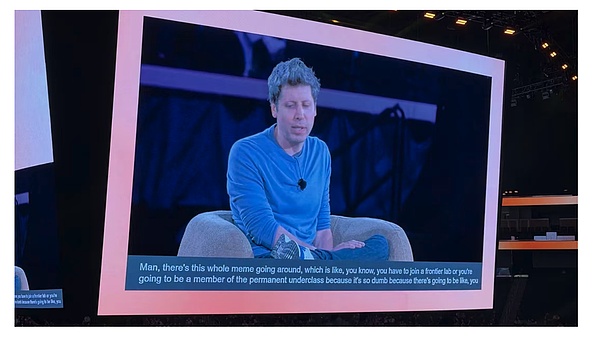
On July 26, Sam Altman stood on the stage at the Chase Center in San Francisco and said, "The idea that you'll fall into the bottom forever if you don't get into cutting-edge labs is utterly stupid."
The trendy term "permanent underclass" has once again come into focus.
It gained popularity on Tech Circle X in the summer of 2025, with its theoretical framework derived from "The Curse of Intelligence" and Trammell and Patel's paper "Capital in the Twenty-Second Century".
This statement doesn't just predict that "AI will cause many people to lose their jobs"; it describes a more extreme future: when AI can perform the vast majority of cognitive and physical labor, companies will no longer need to employ as many people to create wealth. Wages will become less important in the economy, and profits will increasingly flow to those who control models, computing power, energy, and data centers.
It's not just that a group of people have temporarily become poorer, but that the labor they relied on for upward mobility has lost its value; it's not just that the rich are richer than before, but that those without capital cannot become capital owners through work—this is what is known as the "permanent bottom."
Without large-scale wealth redistribution, public ownership, or a global progressive capital tax, this theory ultimately leads to a disturbing conclusion:
Almost all assets are likely to gradually flow to the wealthiest group when the AI transformation takes place.
Of course, this is just a deduction, but it reminded me of a small thing.
Over the past year, author Jasmine Sun conducted a nearly clumsy field study. She met with researchers at cutting-edge AI labs one by one, talking for an hour each time, without recording or keeping notes, asking them for their true thoughts on the future of AI, just like an anthropologist.
There's one question she asks almost every time:
Imagine you're facing an average 17-year-old American student. He's not a genius programmer, his grades are only Bs, and he doesn't seem to care much about AI. How would you advise him to prepare for the future?
Almost no one could answer it.
These researchers, with varying political stances and ranging from optimistic to pessimistic about AI, surprisingly shared the same answer:
I don't know. The situation is frightening; there's probably not much work left for him, and he'll be stuck in the most painful transition period...
But the real problem facing that 17-year-old might not be whether he will become poor.
Poverty is not permanent.
There are poor people and the lower class in every era, but being "lower class" in the past is not necessarily a permanent status.
A person can sell their labor for wages, and then exchange those wages for education, housing, and assets; workers can also demand that capital convert a portion of productivity growth into higher wages and better benefits through organization, strikes, and collective bargaining.
This mechanism is not fair, but at least it preserves an upward path.
What's truly jarring about the "permanent bottom" is that it believes the passage itself might disappear.
Looking back at labor history, unions, minimum wage, and weekend systems are all based on the same fact:capital and labor cannot completely replace each other.
Factory owners need workers, and tech companies need engineers, so both sides must sit down and negotiate.
Marx predicted the high concentration of capital, and also offered a solution. Because in his world, workers still held something that capital needed but could not create out of thin air: labor.
Strikes are effective because workers can temporarily withhold them. If workers don't come to the factory, the machines can't operate; if engineers don't write code, the product can't go live.
However, if computing power can buy all the labor that a person can provide, then the amount of labor that a worker can withhold will approach zero.
At that point, the problem won't just be a decline in wages for some, but that capital will no longer need to negotiate with the majority. Workers will find it difficult to accumulate assets through wages, and also difficult to demand a redistribution of profits by stopping work.
What makes the lower class "permanent" is the machine that once sent the poor back to the middle class: labor, bargaining, and asset accumulation have been dismantled.
Evidence that this machine is loosening has moved from theory into pay slips.
Stanford's Digital Economy Lab, using micro-data from ADP covering 4.6 million workers, found that with the popularization of generative AI, employment among workers aged 22 to 25 in occupations with the highest AI exposure has seen a relative decline of about 16%. The unemployment rate for recent graduates in the United States has reached 5.6%, an increase of 1.6 percentage points from three years ago; and the scale of recent graduate recruitment by large technology companies has decreased by 25% in two years.
The elevator is still running normally, but the buttons on the first floor have been removed.
Those who can't answer the question are buying insurance for themselves.
Back to Sun's interview.
Researchers who couldn't answer the question "What should a 17-year-old do?" did not stop their work.
Sun pressed on: If you believe the future is so dangerous, why continue building it?
The answers can be roughly divided into three categories.
The first type genuinely believes that as long as the transition period is weathered, AI can eventually cure diseases and eliminate scarcity.
The second type believes in technological determinism: even if they don't do it, someone else will.
The third type is the most honest, but also the most awkward:
If a major upheaval really does come, at least secure a place for yourself in the future.
This urge to "claim a spot" is changing the flow of talent across the entire AI industry.
A friend of mine who is pursuing a PhD in AI at Berkeley said that about half of his classmates decided to graduate early, and some even chose their dissertation topics based on "which research direction is most likely to get an offer from an AI lab".
Many of Sun's independent writers and policy researchers have also given up their original positions and joined the AI lab.
These claims may sound like jokes, but they are actually influencing the life choices of a generation and constantly drawing talent away from the ecosystem of independent research and public policy.
And those who were taken away were precisely the group most likely to set up the negotiating table.
The fact that factory automation in the 20th century did not generally evolve into violent conflict is largely due to the fact that before machines entered the factory, factories usually had to negotiate with unions: automation had to be explained as a safety upgrade, and wage increases had to be tied to increased production capacity.
Between capital and labor lies a negotiating table.
Today's white-collar workers don't have this desk.
More subtly, those most capable of setting the negotiating table—academics, independent researchers, and policymakers—are being persuaded to enter laboratories by the narrative that "labor is about to lose its value." Thisis because only by entering the laboratory can they potentially acquire equity and align themselves with capital in advance.
This creates a closed loop:
The more people believe that the bargaining power of labor is about to disappear, the more people will give up the bargaining power of construction and instead compete for equity; and the fewer the builders, the faster the bargaining power of labor will disappear.
No one is absolutely safe.
The 17-year-old wasn't entirely without advice.
Faced with the uncertainties brought about by AI, people have offered many answers, which have directly given rise to two reactions.
One approach is to learn AI as quickly as possible and strive to be the last person to be replaced; the other is to acquire AI assets as soon as possible and try to side with capital before labor loses its value.
The latter impulse is particularly evident in Silicon Valley, and even among the wealthy in China.
Some people are willing to go to any lengths to acquire equity in Anthropic, OpenAI, or other cutting-edge AI companies. The theory is simple:if the singularity really arrives, labor may rapidly depreciate, and at that time, what determines a person's situation will no longer be what they can do, but what they have in advance.
Following this logic, as long as one converts their labor income into equity in an AI company before the window closes, they have the opportunity to transform from someone being replaced by technology into someone who owns the technology.
This is also the most alluring aspect of the "permanent underclass" narrative; it not only creates fear but also hints at an escape route:
Since capital can replace labor, we should transform from laborers into capital owners as soon as possible.
The problem is that this path is not for most people in the first place.
OpenAI and Anthropic are not companies that ordinary people can easily buy on the public market. Those who truly have the opportunity to acquire these shares are usually lab employees, early investors, and wealthy individuals with access to the private market.
Therefore, this is almost a circular argument:
To avoid falling to the bottom due to a lack of capital, he needs to first acquire capital that only the upper class can obtain.
More importantly, even if someone successfully acquires the shares, this insurance policy may not be valid indefinitely.
Fernando Borretti, the author of the programming language Austral, points out that there is actually a contradiction within the theory of "permanent underlying layers".
If AI can indeed complete almost all cognitive and physical labor at a lower cost, then while ordinary workers may lose their economic value, those who hold shares in AI companies in advance may not necessarily become the "permanent upper class."
The reason is simple: wealth is not written in the laws of nature.
A person owns a company, land, or computing power not only because their name is on the contract, but also because the courts, police, and governments are willing to recognize and protect that property right.
However, if we continue to extrapolate from the premise of "super AI replacing everything," AI may eventually be able to handle even production, management, governance, and warfare. At that point, today's wealthy will neither provide labor nor possess any real power beyond machines. So why should future nations or superintelligent systems forever acknowledge the ownership rights they acquired in the old era?
Buying equity in an AI company might help someone get through a transition period, but it doesn't guarantee they'll stay at the top permanently.
If owning AI assets is not a path everyone can take, the more common answer is to learn AI.
Another paradox arises from this path:
The better someone is at using AI to improve productivity, the more likely they are to help a company reduce its need for other workers.
He might be able to stay in the elevator temporarily, but he's also involved in removing the buttons for other floors.
This doesn't mean people shouldn't learn AI. For individuals, becoming proficient in AI may still be the most sensible option right now. The problem is that when everyone tries to avoid being replaced by improving their own substitutability, the end result may be that businesses need fewer workers.
Individual rational choices, when combined, may actually accelerate the decline of overall bargaining power in the labor market.
Another option is to leave the fields most easily replicated by AI and turn to work that requires in-person presence.
If the supply of digital products approaches infinity, then physical operations, on-site responsibilities, and interpersonal trust that cannot be replicated remotely may indeed command a higher premium.
Data centers need electricians, aging societies need caregivers, and people are still willing to pay for the real presence of doctors, teachers, and service personnel, but this is not a fallback option for everyone.
These appear to be three different paths, but they all actually answer the same question:
How can I delay my fall?
But the answer that 17-year-old really needs might be:Why must a person's survival depend on whether he can still be needed by capital?
The researchers couldn't answer this question because what's ultimately needed isn't a personal plan, but a new distribution system.
When labor remains irreplaceable, wages, unions, and strikes together constitute the distribution mechanism; if labor truly begins to lose its scarcity, then society must find another way to distribute the wealth created by machines to those who are no longer needed by the machines.
This issue cannot be solved by everyone working harder to learn AI, nor can it be accomplished by everyone buying a few stocks in advance.
What individuals can buy is only a buffer period; what they truly lack is still the negotiating table.
A negotiating table
Setting up a negotiating table is something that no individual effort can replace.
China unexpectedly provided a control sample.
In December 2025, a Beijing court ruled that job replacement by AI cannot directly constitute a legitimate reason for dismissal. Some employees of state-owned enterprises also stated that the AI tools they use can roughly accomplish the work of two employees, but the company promised not to lay off employees on the grounds of AI.
After spending two weeks in China, Sun concluded thatthe social attitude there was not simply technological optimism, but a pragmatism of "resistance is unrealistic, so let's get on board first."
But at least, someone is trying to catch those falling during the technological transition with a multitude of fragmented rules and legislation.
The United States, on the other hand, is closer to a systemic vacuum.
In April 2026, someone threw a Molotov cocktail at Altman's San Francisco residence; that same month, a city councilor who supported data center projects was shot in his home. At graduation ceremonies, boos targeting AI company executives also began to appear.
When emotions cannot find an institutionalized outlet, they will find their own.
Meanwhile, data from the Federal Reserve Bank of St. Louis shows that 39% of U.S. GDP growth in 2025 will come from investments in data centers and AI.
The entire country is betting its growth on a technology from which most of its citizens will not immediately see any benefits.
The United States will hold midterm elections in 2026, and the primaries of both parties in 2028 are destined to be crowded. Mark Kelly, Ro Khanna, and Josh Hawley have all released their AI action platforms.
Therefore, there may only be one indicator most worth observing in the next two years:
Can that negotiating table be set up before anger sets in?
It could be a law stipulating that companies cannot simply translate all productivity gains into layoffs; it could be a new form of labor union that allows employees of the same company, regardless of their profession, to participate in negotiations for AI deployment; or it could be a check bearing the name of an AI company, redistributing the benefits of technology creation to those who bear the costs of transformation through taxes, dividends, or public funds.
The specific form has not yet been determined, but the core issues can no longer be avoided:
When businesses no longer need to create wealth by employing the majority of people, why should the majority share in that wealth?
As for the 17-year-old who only got a B, he will probably never know:
When the smartest people in the industry are asked, "What should we do with him?", their answer is, "There is no answer."
Then they went back to their respective homes and continued to buy insurance for themselves.
Source:Global Cybersecurity Alliance (GCSA)
Website:www.gcsa.org
Get updates in your inbox
We respect your privacy. See our Privacy Policy